fogoly [ otthon, felejtős, polc, képek ]
Nov 03, 2026
Dante (1265–1321) places Aristotle (384–322 BCE) in Limbo (Inferno IV) — and in the philosophic family gathered around him, his own two Muslim commentators:
When I had raised my eyes a little higher, / I saw the master of the men who know / seated in philosophic family. — Dante, Inferno IV.130–132 (trans. Mandelbaum; Petrocchi ed.)
and Euclid the geometer, and Ptolemy, / Hippocrates and Galen, Avicenna, / Averroes, of the great Commentary. — Dante, Inferno IV.142–144 (trans. Mandelbaum; Petrocchi ed.)
We know the first of these is Aristotle partly because Plato and Socrates sit closest to him, and partly because by Dante's time he was simply "the Philosopher" in Latin Christendom, as Homer was "the Poet" for the Greeks: an antonomasia, the title standing in for the name.
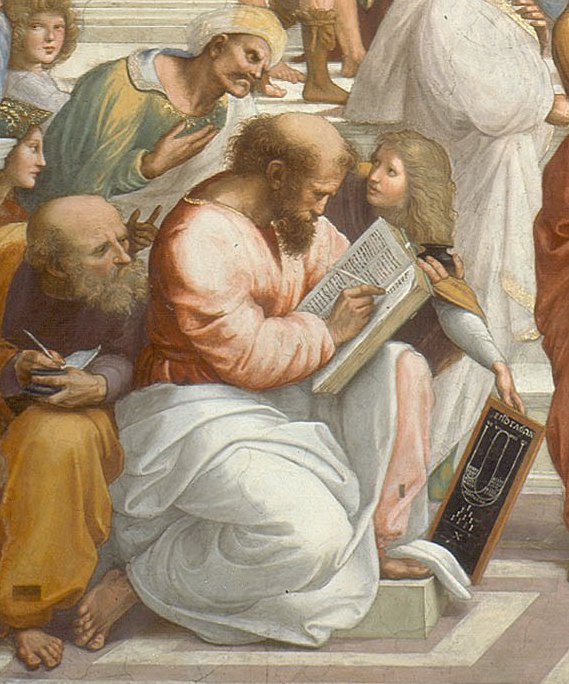
Aristotle reaches Latin Christendom already filtered through centuries of Arabic engagement — which itself draws on an even older Syriac one. Syriac Christian scholars, centered on schools like Nisibis and Edessa, had already been translating and commenting on Aristotle's logical works for generations before the translation movement in Baghdad began in the mid-8th century; Sergius of Reshaina (d. 536), trained in Alexandria, is the earliest figure whose Aristotle translations and commentaries survive. The 8th–10th century Abbasid translation movement in Baghdad draws directly on this existing Syriac Christian scholarly work; al-Farabi (c. 870–950) and then Avicenna (Ibn Sina, 980–1037), in the metaphysics of his Kitab al-Shifa ("The Book of Healing"), rework it into a systematic Neoplatonic-Aristotelian synthesis. Averroes (Ibn Rushd, 1126–1198), more than a century later, writes three tiers of commentary — Short, Middle, and Long — covering nearly the whole Aristotelian corpus, earning him the title of "the Commentator". Gerard of Cremona (c. 1114–1187) carries much of Aristotle himself into Latin at Toledo; Michael Scot (c. 1175 – c. 1232), first at Toledo and then in Italy, translates Averroes's Long Commentaries in the 1220s and 30s. Even before Averroes arrives, the Arabic-mediated Aristotle causes scandal: in 1210, after the pantheism affair around Amalric of Bena and David of Dinant, Paris bans the teaching of his natural philosophy. The ban eventually lapses, and by 1255 the works are required reading there. But back to the topic at hand.
Why can these non-Christian men be in Limbo at all? The first problem is that they are adults, not even that they are pagan — the Scholastic limbus was for the Old Testament righteous, before the Harrowing (Descensus Christi ad Inferos) emptied it, and for unbaptized infants — not for adult pagans however virtuous they may be. On Aquinas's own account, an adult who dies in original sin plus actual unbelief goes to Hell, not a castle with no torment where they can hang out with others.
"It is impossible for venial sin to be in anyone with original sin alone, and without mortal sin. The reason for this is because before a man comes to the age of discretion, the lack of years hinders the use of reason and excuses him from mortal sin [...] But when he begins to have the use of reason, he is not entirely excused from the guilt of venial or mortal sin. Now the first thing that occurs to a man to think about then, is to deliberate about himself. And if he then direct himself to the due end, he will, by means of grace, receive the remission of original sin: whereas if he does not then direct himself to the due end [...] he will sin mortally, through not doing that which is in his power to do." — Thomas Aquinas, Summa Theologiae I-II, Q. 89, A. 6 (trans. Fathers of the English Dominican Province)
There is no Church authority putting Aristotle, Avicenna, or Averroes anywhere in Limbo; this is Dante's personal addition.
In Paradiso X, among the twelve wise spirits ringing the sun, is Siger of Brabant (c. 1240 – c. 1284) — the radical Latin Averroist whose doctrine of the unity of the possible intellect Aquinas wrote an entire treatise against, De Unitate Intellectus contra Averroistas. It's Aquinas himself, speaking in the canto, who names and praises him.
This makes me think of Simplicius (c. 490 – c. 560), who is a pagan Neoplatonist, writing after Justinian closed the Academy and commenting on Aristotle. The gratitude he expresses is the same gratitude Aquinas performs for Siger and that Dante performs for the whole philosophic family:
"And if I myself too have had the strength to add anything, for this as well thanks are due, after the gods, to these men, led by whose hand I have added either a difficulty not to be cast aside, or some articulation of what has been said that is worth a mention." — Simplicius, commentary on Aristotle's Categories
Simplicius is one of the most important sources for the Presocratics, preserving the bulk of Parmenides' poems and most of what we have of Anaxagoras!
Aristotle's confinement in Limbo is permanent, along with other pagan wise men. The only exemption doctrine recognizes occurred during the three days between the Crucifixion and the Resurrection — Christ's descent into Limbo, a dogma rooted in 1 Peter 3:19–20 ("he went and preached unto the spirits in prison") though the specific roster of souls he freed comes not from scripture but from the apocryphal Gospel of Nicodemus, a tradition Dante draws on — and took the righteous of the Old Covenant: pre-Christian Hebrew figures who could be read as having implicit faith in a Christ yet to come.
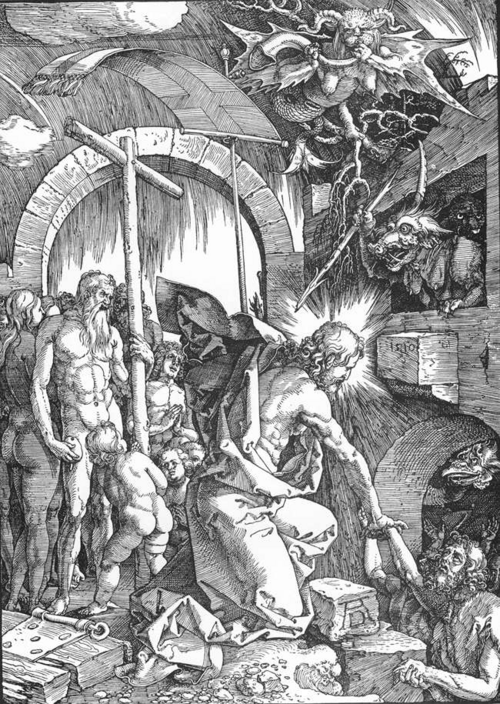
Dante allows two further exceptions: in Paradiso XX, Ripheus (a minor Trojan predating Christ) and the emperor Trajan (who postdates him) also appear among the blessed — each through an engineered miracle, which we won't cover.
Aristotle and company get no exception, and cannot be saved. But they don't receive active physical punishment (as is customary in the inner circles of Hell), only what scholastic theology calls poena damni, the pain of loss — the loss of "seeing God face to face", as promised in 1 Corinthians 13:12: "for now we see through a glass, darkly; but then face to face." As the canto itself puts it, "we have no hope and yet we live in longing" (Inf. IV.42). Virgil resides here as well — this will become important later.
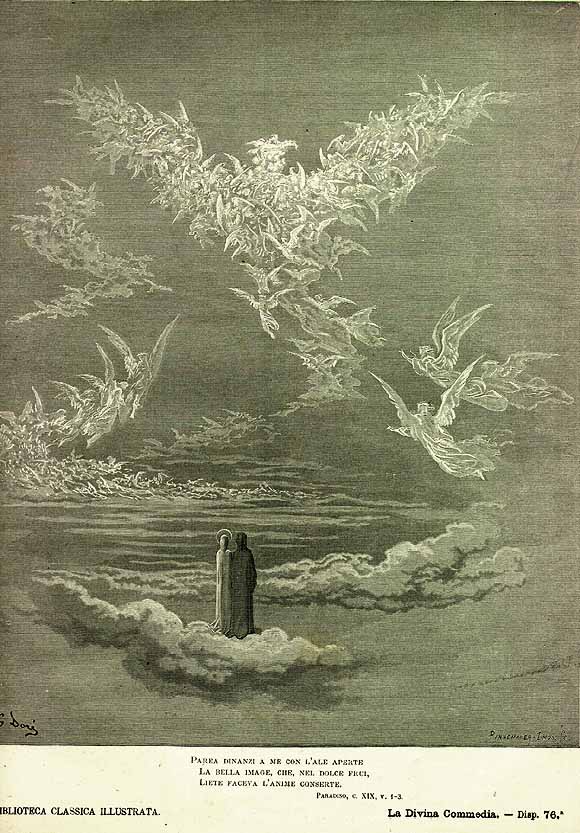
Dante (the author) poses a geographical version of the same problem in Paradiso XIX, though not aloud: the Eagle of Justice reads the doubt in his (Dante the character's) mind and voices it before he can put it into words:
A man is born along the shoreline of the Indus River; none is there to speak or teach or write of Christ. And he, as far as human reason sees, in all he seeks and all he does is good: there is no sin within his life or speech. And that man dies unbaptized, without faith. Where is this justice then that would condemn him? Where is his sin if he does not believe? — Dante, Paradiso XIX.70–78
Rather than answer, the Eagle disqualifies the questioner:
Now who are you, that you would sit in judgment a thousand miles away, with vision that can see no farther than a hand's-span? — Dante, Paradiso XIX.79–81
It makes sense he'd be this preoccupied with a question like this: Virgil, his own beloved guide and inspiration, is stuck in Limbo too, not just these excellent philosophers. Dante has a personal stake in this.
How could they have known what the right religion was? Why would it be righteous to punish them for this? The Scholastic term for this is invincible ignorance, though for Aquinas it only excuses the unbelief; it does not save (Summa Theologiae II-II, Q. 10, A. 1). The distinction itself is already in Aristotle's own Ethics:
"Everything that is done by reason of ignorance is not voluntary... ignorance of particulars, i.e. of the circumstances of the action and the objects with which it is concerned. For it is on these that both pity and pardon depend, since the person who is ignorant of any of these acts involuntarily. [...] Indeed, we punish a man for his very ignorance, if he is thought responsible for the ignorance... we assume that it is in their power not to be ignorant, since they have the power of taking care." — Aristotle, Nicomachean Ethics III.1, III.5 (trans. W. D. Ross)
This problem is present in all Abrahamic religions, because a soteriology becomes a justice problem when it makes salvation contingent on receiving a specific revealed message — and whether that message reaches you is itself contingent, this time on history rather than grace.
In Judaism the Noahide covenant, a minimal set of universal laws binding on all humanity since Noah, gives righteous gentiles a share in the World to Come without ever requiring exposure to the Torah at all: "the righteous of the nations of the world have a share in the World to Come" (Tosefta Sanhedrin 13:2).
Islam's Ahl al-Fatrah, "the people of the interval" — those who died in a period or place a prophetic message never reached — rests on the Qur'anic principle that God does not punish until He has sent a messenger (Q. 17:15). According to one hadith, on the Day of Judgement those whom the message never reached will be given a test of obedience that decides if they go to Jannah or not.
"There are four kinds of people on the Day of Resurrection: a deaf man who cannot hear anything, a mad man, a senile man, and a man who died in the period before Islam. [...] The man who died before Islam will say: O Lord, there was no messenger from You who came to me. Allah will make them promise to obey Him. Then, He will command them to enter the fire. By the one in whose hand is the soul of Muhammad, if they enter the fire, it will become cool and peaceful." — Hadith of al-Aswad ibn Sariʿ, Musnad Ahmad 16301 (trans. Abu Amina Elias)
Christianity's own answer to why any of this partial access to truth is even possible comes from Justin Martyr's (c. 100–165) λόγος σπερματικός — the Christian apologist's notion that even before the coming of Christ, the truth these philosophers revealed was from the Logos — Christ — even before his incarnation. For the Stoics, from whom he borrowed the term, the logoi spermatikoi (plural) were the seed-principles in things, generating the cosmos. Justin Martyr's repurposing of this idea is a partial acquittal of pagan philosophy: the same Logos that philosophers of old derived their wisdom from is the Logos that becomes incarnate in Christ.
"...I confess that I both boast and with all my strength strive to be found a Christian; not because the teachings of Plato are different from those of Christ, but because they are not in all respects similar, as neither are those of the others, Stoics, and poets, and historians. For each man spoke well in proportion to the share he had of the spermatic word, seeing what was related to it. [...] For the seed and imitation imparted according to capacity is one thing, and quite another is the thing itself, of which there is the participation and imitation according to the grace which is from Him." — Justin Martyr, Second Apology, ch. 13 (trans. Roberts & Donaldson)
Historically, Dante could not have known this text — it was not accessible to any Latin reader in his lifetime. The Greek text survives in essentially one manuscript, copied in 1364, decades after his death; but he might have been familiar with Justin Martyr's life from biographical sources. However, this is a doctrine articulated over a thousand years earlier in church history, so it's definitely not a big stretch to say that these ideas lingered around for some time. In fact there is a Latin version of this, “all truth, by whomever spoken, is from the Holy Spirit,” from Ambrosiaster (writing c. 370s–380s), and this one does reach Dante's world: Aquinas quotes it, under Ambrose's name, in Summa Theologiae I-II, Q. 109, A. 1, ad 1.
Justin extends the same logic to explain why virtuous pre-Christian pagans specifically shouldn't be dismissed as irresponsible — in the older sense of the word, not accountable, not liable to be judged, rather than the modern "careless":
"...and should cry out against us as though all men who were born before Him were irresponsible — let us anticipate and solve the difficulty. We have been taught that Christ is the first-born of God, and we have declared above that He is the Word of whom every race of men were partakers; and those who lived reasonably are Christians, even though they have been thought atheists; as, among the Greeks, Socrates and Heraclitus, and men like them..." — Justin Martyr, First Apology, ch. 46 (trans. Roberts & Donaldson)
I admit I am not very well versed in Avicenna and Averroes but I will try to put these debate in context. Aquinas takes the essence/existence distinction from Avicenna — reworking esse from something like an accident of essence into the very act that actuates it — and is closer to Averroes than to Avicenna on the unicity of substantial form, though he drops Averroes's indeterminate dimensions aswell.
This is a very metaphysical kind of theological argument that people were having spanning hundreds of years, paradigms shifting with each philosopher proving the other wrong, or surpassing the other in theory.
Avicenna and Averroes are important in the medieval European reception because they had extensive commentaries on Aristotle, these were more or less imported wholly into Europe as stated earlier.
A bit of background. For Aristotle, every physical thing (substance) is a unity of matter and form (hylomorphism). Matter is paired with a substantial form, which formally makes it what it is: water, a dog. The soul is the substantial form of living things, the substantial form of the living body. Accidents are properties that sit on the thing without changing its essence: color, size, location. If you paint a pine cone, the change is accidental, the pine cone does not change in its essence. If you throw it in a campfire, and it turns to ash, that changes it in a substantial way, it is no longer a pine cone, it's ash. The pine-coneness is gone, ashness remains. There must be some thing during this type of change that is kept even if the thing changes substantially, that allows for the potential to change. This is prime matter, it's pure potentiality, it's what is left if you strip away every form, and it cannot exist on its own. This is the substrate that persists through substantial change.
There are also the categories, this is what determines what you can say about the thing. Substance for example, is concerned with what a thing is, quantity, how much or how big it is, and quality will let you say what the thing is like. Quantity is measurable and quality comes in degrees. From what I understand, the debate between Avicenna and Averroes concerns how prime matter comes to have quantity (extension).
"When all else is taken away evidently nothing but matter remains. For while the rest are affections, products, and potencies of bodies, length, breadth, and depth are quantities and not substances [...] But when length and breadth and depth are taken away we see nothing left unless there is something that is bounded by these [...] By matter I mean that which in itself is neither a particular thing nor of a certain quantity nor assigned to any other of the categories by which being is determined." — Aristotle, Metaphysics Z.3, 1029a10–21 (trans. W. D. Ross)
Quantity is something of a horizon, it defines how far a thing reaches in each direction. The pine cone's surface is its boundary, let's say it's 8 cm in diameter, that's as far as the boundary goes, what is this boundary a boundary of, then? If you take away the borders, anything that is left is what those borders were enclosing. For Aristotle matter is strictly substrate, but matter has no size of its own, so where or how does it get its capacity to be delimited?
How I think about this is, coming from the ontological supposition that there is at least space, where static, non-changing existence is. For it to be possible to have any thing in that space (let's ignore becoming and change for now), things have to be delimited from the space, so space has to be first delimited from the void itself, which can be filled with the things or something like that. The idea is that the boundary of a thing and space has to exist in order for the thing to be differentiated from its surroundings, and for there to be any surrounding at all. To have a boundary, a thing has to be extended, it has to become actual in space.
Avicenna and Averroes disagree on whether prime matter always comes bundled with a minimal corporeal form (the forma corporeitatis) before any further substantial form — "being flesh," "being water" — gets added to it. Their disagreement is on how matter can be a body before it's anything specific.
When you throw a pine cone in a fire and it burns to ash, the stuff never stops being somewhere, never stops filling space and the change looks continuous.
For Avicenna there are three layers: prime matter being the base layer, in the center, the next layer being the corporeal form, and the next layer being the substantial form, in this case: the pine-coneness. So it's three rings, and only the inner two persist. The corporeal form is the layer that makes matter a body, something that can have length, breadth and depth; the definite measurements only come with the outer ring, and they go with it.
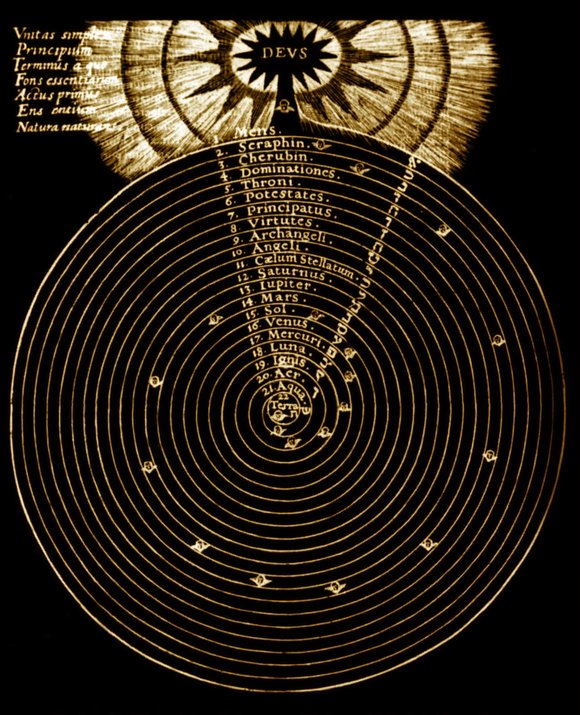
As far as I understand, for Averroes there is only the prime matter with some immanent indeterminate dimensions, and the substantial form. So it's two rings, and only the center persists, along with its indeterminate dimensions. An indeterminate dimension is something that cannot be measured but can be identified for being a dimension because it describes quantities generally, so instead of being able to tell "how long is it" you can only tell that "it has some length".
For Aquinas there are two rings, but the center has no corporeal form or indeterminate dimensions and the second layer, substantial form, makes everything. In a pine cone, the pine-coneness makes it a pine cone and a body. In a human, the soul makes it human, alive, and a body all at once. This is the unicity of substantial form, as opposed to Avicenna's plurality.
Okay, but how is this highbrow metaphysical problem related to the everyday life of Christians? Well, if you put a human body in place of the pine cone, the pine-coneness is the soul now, as it is the form of a living being, what happens when a person dies? At death the soul leaves, just as pine-coneness left when we cast it in the fire, but then what remains?
For Avicenna the corporeal form stays, the corpse is the same body, just dead. For Averroes the indeterminate dimensions stay, something extended remains. For Aquinas only bare matter remains, the body is no longer his body in the strict sense.
"Suppose that the eye were an animal — sight would have been its soul, for sight is the substance or essence of the eye which corresponds to the formula, the eye being merely the matter of seeing; when seeing is removed the eye is no longer an eye, except in name — it is no more a real eye than the eye of a statue or of a painted figure." — Aristotle, De Anima II.1, 412b18–22 (trans. J. A. Smith)
Aquinas's account can handle the resurrection: the soul survives death on its own, and since it is the only form, whatever matter it informs again becomes this same body, the same man. The identity is carried by the soul, not by the matter, so not every particle has to come back (Summa contra Gentiles IV.81). The body is lent, given back on death, and lent again.
Fine, resurrection can be explained in a satisfactory way, but what about the time in between death and resurrection? For an ordinary person it doesn't matter much that their corpse is only "by name" theirs, nobody needs it to be them. For Christ it does: the Creed says he "was crucified, died, and was buried", so whatever lay in the tomb has to be him, and it is the same body that is promised not to "see corruption" (Psalm 16:10, read onto Christ in Acts 2:27). So during the three days between the Crucifixion and the Resurrection, after Christ's soul had departed, was the body lying in the tomb still Christ's body?
"It is an article of faith that Christ was truly dead: hence it is an error against faith to assert anything whereby the truth of Christ's death is destroyed. [...] Now it belongs to the truth of the death of man or animal that by death the subject ceases to be man or animal; because the death of the man or animal results from the separation of the soul, which is the formal complement of the man or animal. Consequently, to say that Christ was a man during the three days of His death simply and without qualification, is erroneous. Yet it can be said that He was "a dead man" during those three days." — Thomas Aquinas, Summa Theologiae III, Q. 50, A. 4 (trans. Fathers of the English Dominican Province)
Following Aquinas's answer: Christ was not "a man" during the triduum at all, since the soul — the one substantial form — had separated from the body.
The soul leaving the body does not break Christ's identity, because that identity rests on the hypostatic union: Christ is one person, the Word, the second person of the Trinity, who has two natures, a divine and a human one. Person is the "who", nature is the "what", so Christ is one "who" with two "whats". This union doesn't depend on the human nature's own parts staying joined to each other. The Word remained personally united to the separated soul and to the separated body individually, even though the ordinary human separation of soul from body — death — had occurred. The body in the tomb was the same body "simply", because of its union with the divinity, and not the same only "in a certain respect", because it was no longer alive (Summa Theologiae III, Q. 50, A. 5).
And this is where we get back to Limbo. Where was Christ's soul during those three days? In Limbo. The same three days, the body in the tomb and the soul among the righteous of the Old Covenant, both still held by the Word. The only exemption from Limbo that doctrine recognizes happened while Christ's body was lying in a tomb, and what kept that body his is a question Aquinas could only answer the way he did because of how he sided in a dispute between two Muslims who are themselves stuck in Limbo, along with Aristotle.
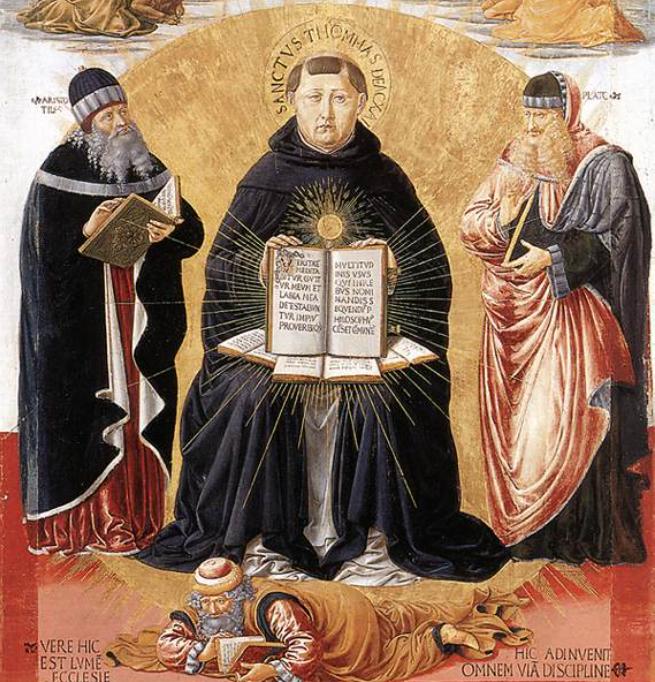
Thinking about how much Christian theology owed to these people, I think it's fitting that they are placed not among the tormented (even though Limbo is still the first circle of Hell), but I feel like they should have at least gotten a place of eternity where they can continue their work toward God. That being said this Limbo is already Dante softening the doctrine well past anything permitted in his time, they receive no torment, no demons, but a castle and good company, not to forget that they get to keep their honor. As it stands in the Divine Comedy, they are forever apart from the Light, just as they were when they were alive, they can work and converse with others all they want, but even their combined efforts will not reach what they always wanted to reach, God. They are not punished, but they are condemned to longing — even though they never had a choice in the matter. This is why Justin Martyr's argument feels very convincing, and I'm overcome with the same sadness about the fate of these men that I felt when I first read Plato's Apology, but I guess...
Now who are you, that you would sit in judgment… — Dante, Paradiso XIX.79